
Criminal Court Cases in Crenshaw County
Crenshaw County is part of Alabama's Second Judicial Circuit. Circuit Court is the felony trial court. It also receives appeals tried anew from District or municipal court. District Court handles misdemeanors, traffic matters, and the early stages of felony cases, including preliminary proceedings. A municipal court keeps its own ordinance, traffic, and qualifying misdemeanor docket for conduct within that city. The court level matters because it tells a reader which case file to request and how to interpret an early District Court entry that later becomes a Circuit Court prosecution.
The Crenshaw Circuit Clerk is the official record keeper for both Circuit and District proceedings. The criminal, traffic, juvenile, and warrants divisions are within that office. Filed complaints, indictments, motions, rulings, pleas, judgments, and sentences therefore belong to the court record rather than the sheriff's booking file. Brantley Municipal Court separately holds Brantley ordinance and municipal misdemeanor matters. A city citation should not be assumed to exist in the county docket until the correct court is confirmed.
Crenshaw County Courts by Charge
One charge may touch two court levels. A felony complaint can start in District Court, proceed through a preliminary stage, and reach Circuit Court after a grand-jury indictment. A misdemeanor usually remains in District Court unless it arose under a city ordinance or other municipal authority. That route explains why a single name search can yield more than one entry or why a District entry may not contain the final felony judgment.
- Complaint
- A sworn document that starts a criminal accusation and states the alleged facts.
- Indictment
- A grand jury's formal felony charge, also called a true bill.
- Disposition
- The recorded end of a charge, such as conviction, dismissal, acquittal, or nolle prosequi.
- Capias
- A court command to take a person into custody, often tied to a missed appearance or later case event.
These terms mark different events, not interchangeable outcomes. A complaint is not a conviction, and an indictment is not a verdict. The latest disposition line and signed order carry more weight than the first charge description.
Crenshaw County Case Record Searches
Just One Look offers fee-based, case-by-case access to Alabama trial-court records. It supports name and case-number search modes. The public screen does not expose its full filters until login and payment, so date-of-birth filters, wildcard behavior, limits, and post-login menus should not be assumed. A no-match still counts as a paid search. If the service does not resolve the case, the Crenshaw County Circuit Clerk provides the direct counter, phone, and mail fallback.
- Start with a case number when one is known. Otherwise, use the full name and check likely name variants.
- Review the court, case number, case status, parties, and action summary before buying any added image or access option.
- Match filing dates and charges to the event being researched. Do not rely on a same-name result alone.
- Read the newest action and final disposition, not just the first complaint or booked charge.
- For missing images, old files, or a certified record, call or visit the Circuit Clerk and provide the case number or name plus an approximate year.
| Public control | Type | Access | Verified notes |
|---|---|---|---|
| Name search | Search mode | Account and payment | $9.99; a no-match counts as a search |
| Case Number | Search mode | Account and payment | $9.99 per search |
| Sign Up / Login | Account control | Required to purchase | Account collects contact and address fields |
| Document Images | Purchased add-on | Optional | $5 for the first 20 pages, then $0.50 per page |
| Lifetime access | Purchased add-on | Optional | $19.99 District case; $29.99 Circuit case |
The official Just One Look login shows the remote access starting point.
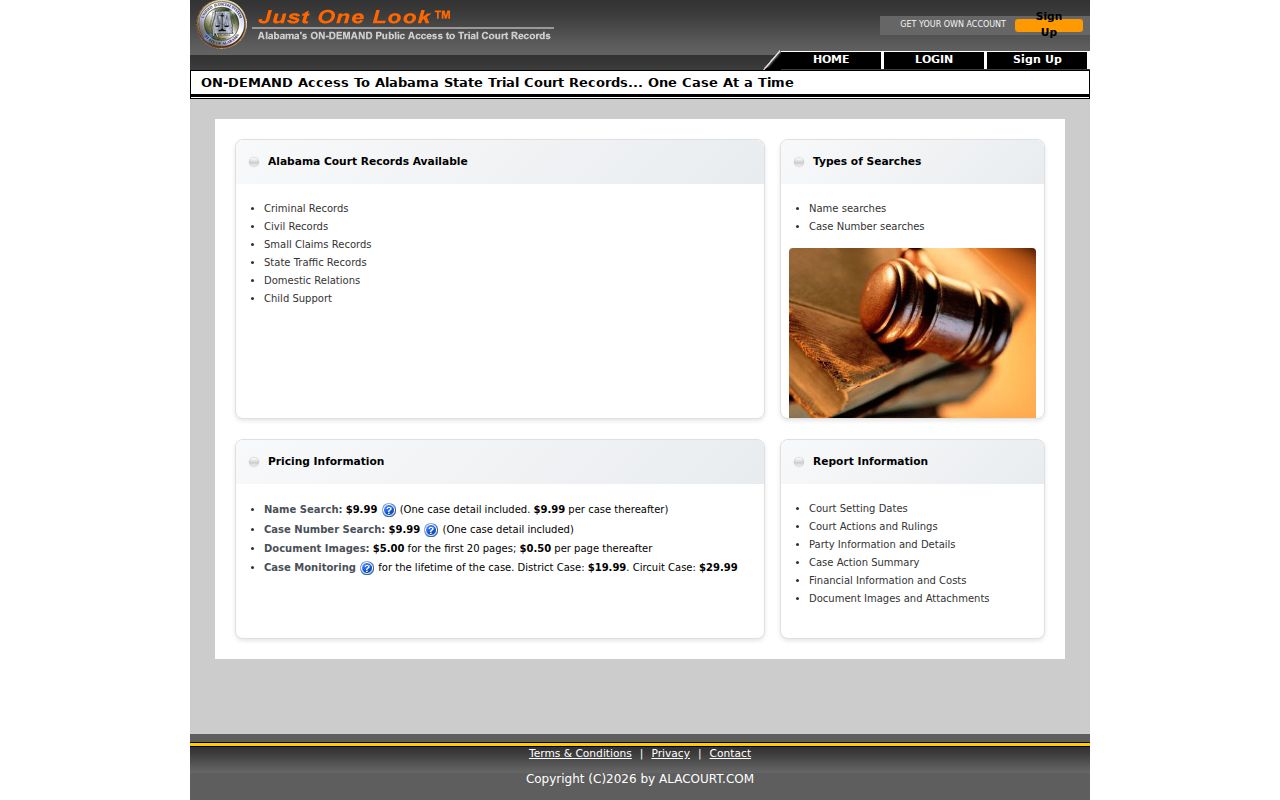
The image confirms the account-gated route without implying that a private case or post-login field was inspected.
Note: AlaPay handles eligible payments; it is not a substitute for searching or reading the full Crenshaw County court case file.
When Crenshaw Court Images Are Missing
A paid result may list the case yet omit the document needed. Older paper material, a misindexed name, a file not yet imaged, or a protected document can also defeat remote access. Contact the criminal division at the Crenshaw County Courthouse with the case number, full name and aliases, and an approximate filing year. Ask whether the record is available for free viewing at the counter, whether a plain or certified copy can be ordered, and what cost and delivery time apply. Crenshaw County does not publish local copy prices, an archive cutoff, a request form, or an email channel.
Crenshaw Circuit Clerk
Crenshaw County Courthouse
29 South Glenwood Avenue, Suite 206
Luverne, AL 36049
P.O. Box 167, Luverne, AL 36049
334-335-6575
Monday-Friday, 8:30 a.m.-4:30 p.m.
The clerk can distinguish a missing public image from a confidential or expunged file, but cannot give legal advice. Call before travel if accommodations, device rules, or access to an archived volume must be confirmed.
What a Criminal Case File Contains
A Crenshaw County criminal file is case-centered. It tracks one prosecution through filed documents and judicial action. The useful fields are not limited to a charge label. Searchers should connect the case number, court, filing date, parties, docket sequence, disposition, and sentence. The same event may look different in an arrest report, jail booking, ALEA history, and court file because each product records a different stage.
| Case Number & Court | Identifies the unique file and whether Circuit, District, or municipal court holds it. |
|---|---|
| Charging Document | Shows the filed complaint, information where allowed, or grand-jury indictment. |
| Docket Entries | Lists filed motions, notices, rulings, warrants, and other actions in date order. |
| Hearing Dates | Records scheduled and completed court events, including arraignment and trial settings. |
| Disposition & Judgment | States how each charge ended, which may include conviction, acquittal, dismissal, or nolle prosequi. |
| Sentence & Conditions | May show custody, a split or suspended term, probation, fines, costs, restitution, and credit. |
Financial entries can separate bond, fines, court costs, restitution, payments, and balances. A balance is not itself the disposition. Likewise, “disposed” means that the court ended the matter, not that the result was necessarily a conviction.
Read Crenshaw County Docket Changes
The booked allegation can change before or after filing. The prosecutor may file a different count, the grand jury may return another charge or no-bill, or the court may dismiss a count. Compare the arrest date and agency with the complaint or indictment, then move forward through the docket. A nolle prosequi means the prosecutor ended that prosecution at that time. It does not erase the arrest. An acquittal is a not-guilty result after trial, while a dismissal is a court-ordered end that may have different terms.
The distinction is especially important when reviewing one's own record. The broader Crenshaw County criminal history overview explains why the arresting agency, jail, clerk, and state repository can each hold a different part of the same event.
Criminal Case Stages in Crenshaw County
Most case files grow in stages. A complaint or arrest can lead to an initial appearance and bond decision. District Court may handle the early felony process before a grand jury acts. If an indictment issues, Circuit Court arraigns the accused, hears motions, and moves the case toward plea or trial. The court then enters judgment and, after conviction, imposes sentence. An appeal may create another record in the proper appellate court.
Case flow: Charges Filed › Arraignment › Pretrial › Plea or Trial › Disposition › Sentencing
The Alabama Judicial System publishes its criminal-procedure forms appendix for the state forms that support these steps.
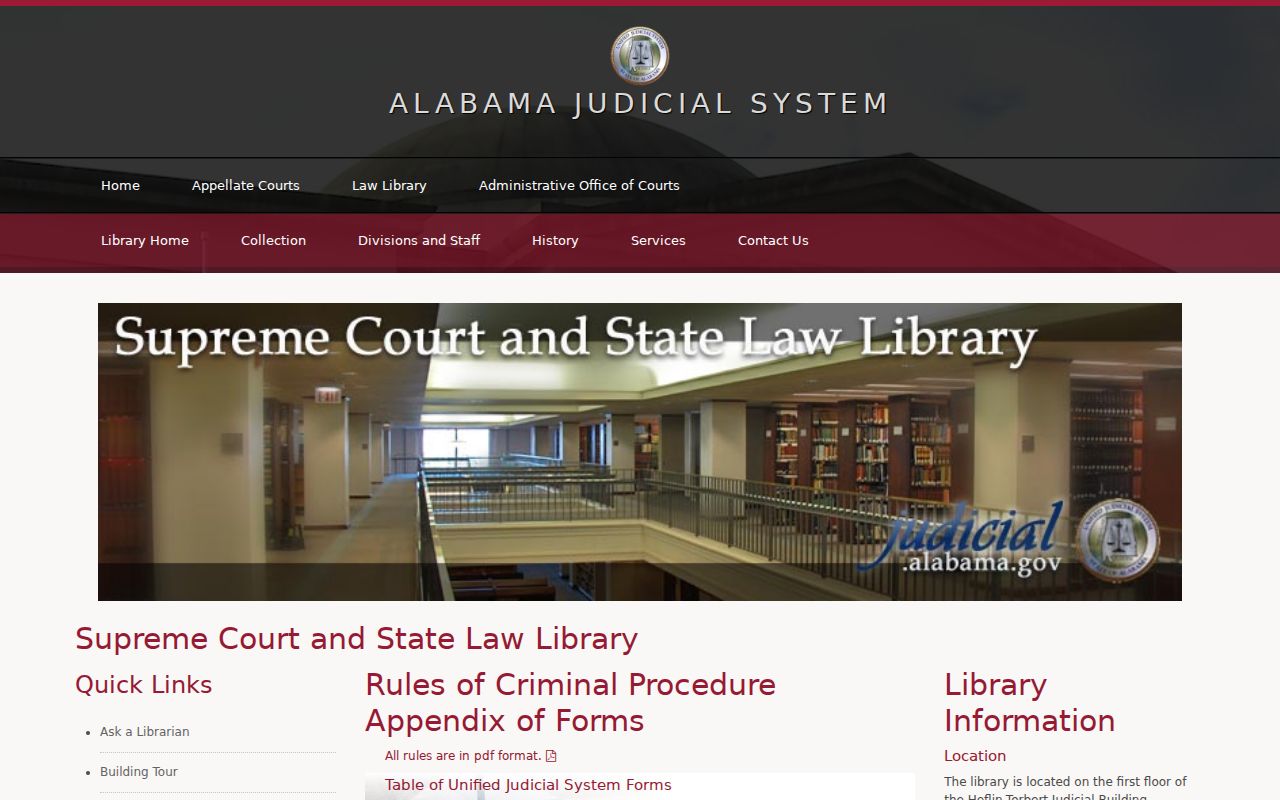
The forms help identify an arrest warrant, appearance bond, complaint, indictment, and other process without substituting a blank form for the signed Crenshaw County filing.
Crenshaw Court Copies and Certification
Remote access, a counter inspection, a plain copy, and a certified copy serve different needs. Just One Look offers paid case data and optional images. Alabama's court privacy rules state that Circuit and District electronic dockets and court records may be viewed at the clerk's office without an access charge, subject to confidentiality rules. Copies may carry a fee. Certification is the clerk's formal attestation that the copy comes from the official file.
Ask for the exact document, not merely “the record.” A case-action summary may answer a status question, while a charging instrument shows what was filed and a judgment or sentencing order proves the outcome. Since no Crenshaw fee schedule appears online, request a written cost estimate before ordering a large file. Mail requests should use the clerk's P.O. Box and include enough detail for staff to identify the case.
Access Rules for Case Records
Alabama's court records start with a public-access rule, but not every field or file is open. The Rules of Court-Record Privacy and Confidentiality protect specified identifiers and confidential material. Juvenile and Youthful Offender matters, victim or minor information, sealed documents, and expunged cases may be hidden or redacted. “Redacted” means a public copy remains after protected data is removed. “Confidential” means ordinary inspection is blocked.
The Alabama Open Records Act supplies a broader right to inspect public writings, but court-specific rules still control the judicial file. A no-result does not prove that no case ever existed. It may reflect spelling, court level, timing, old paper records, or a lawful restriction. Ask the clerk which reason applies without demanding confidential details.
Note: An expunged Crenshaw County case is removed from ordinary public access, though Alabama law preserves limited official retention and access.
Correcting a Crenshaw Court Outcome
When an ALEA self-review shows the wrong or missing outcome, begin with the office that created the disposition. Obtain the Crenshaw County case number, final order, and any certified case-action material needed to show the correct result. Then use ALEA Form 46's challenge instructions and identify the challenged charge, arrest or disposition date, and originating court or agency. ALEA's statewide history is person-centered, while the clerk's file is the primary proof of the local judicial action.
A stale third-party copy does not prove that either official system remains wrong. Verify the court display, request a fresh subject review through ALEA, and direct any separate private-provider dispute to that provider with the certified order. This sequence keeps a name-match problem from being mistaken for a Crenshaw County court error.