
Crenshaw County Sex Offender Checks
The official starting point is the Alabama public registry search. ALEA's Criminal Justice Information Services Sex Offender Registry Unit maintains the statewide system. Local law enforcement registers covered people, gathers required data, photographs and fingerprints, and sends that material to ALEA. In Crenshaw County, the sheriff is the local contact for registration questions, suspected errors, and possible noncompliance.
Use the state registry for the public notification profile. Call the sheriff when a Crenshaw County address appears wrong, when a local reporting point must be confirmed, or when the search result raises a compliance concern. The sheriff does not replace the statewide search, and the public profile does not replace the underlying criminal case. A final judgment or sentence belongs in the court file.
ALEA Registry Unit for Crenshaw
The ALEA registry-unit entry identifies the state office that administers Alabama's system. Its public information helps a Crenshaw County searcher separate the statewide publisher from the local office that handles registration and checks compliance.
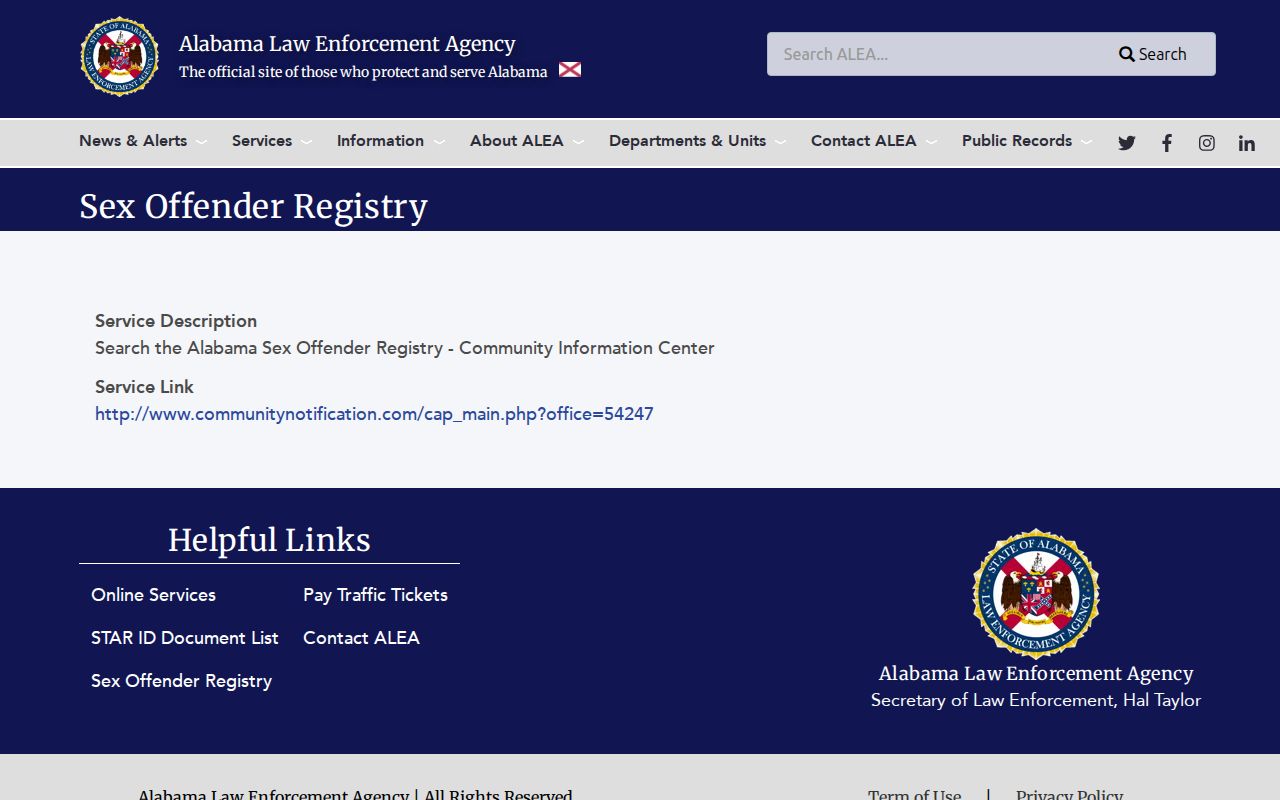
The division of work matters. A person registers through the responsible local law-enforcement agency, while ALEA publishes qualifying data in the Community Information Center. ALEA lists its Sex Offender Registry Unit at 334-676-7898 and sexoffenderunit@alea.gov. A Crenshaw County issue should generally start with the sheriff so the office that can check a local address or reporting event sees it first.
Registry data is meant for awareness and safety planning. It is not a substitute for a call to law enforcement when there is an immediate risk, and no search result authorizes contact with a listed person or household.
Alabama Sex Offender Registry / Community Information Center Searches
Alabama law requires public search capability by name, city or town, county, ZIP code, or geographic radius. The registry vendor presented a JavaScript and anti-bot challenge during research, so exact control labels, required flags, radius choices, sorting, and alert options could not be verified. The steps below stay within the capabilities established by Ala. Code § 15-20A-8 rather than inventing an unseen interface.
- Open the official Alabama registry search and review its use notice.
- Search a known name, or use Crenshaw County, Luverne, another town, a ZIP code, or a radius where the live controls permit it.
- Compare the result with reliable identifiers such as aliases, photograph, physical description, address, and offense details.
- Read the status and date fields, then contact the Crenshaw County sheriff if local information seems stale or incorrect.
| Search category | Type | Required | Verified status |
|---|---|---|---|
| Name | Exact control unknown | Unknown | Search capability required by statute |
| City or town, county, ZIP | Exact controls unknown | Unknown | Place search required by statute |
| Geographic radius | Radius search | Unknown | Capability required; distances and address format not observed |
Note: No proximity-alert signup was verified, so a Crenshaw County alert workflow is not claimed.
Crenshaw County Sheriff Registration Duties
The Crenshaw County Sheriff's Office is the practical local registry contact. Alabama's system depends on local agencies to register covered people and forward required information to ALEA. The Crenshaw County office can receive a report about an address or compliance issue and decide what verification or enforcement step is proper. Public sources do not post registry-counter hours, appointment rules, or a fee for Crenshaw County, so callers should confirm those details before travel.
Crenshaw County Sheriff's Office
89 Folmar Avenue
Luverne, AL 36049
P.O. Box 22, Luverne, AL 36049-0022
334-335-6568
Report facts, not assumptions. Give the profile name, the address or status that appears questionable, and the date the public record was checked. Do not visit the listed address or confront anyone. The sheriff can compare the report with information available to law enforcement, while ALEA can address a state-publishing issue through its registry unit.
Registry Profiles: What They Show
No private person's registry profile was opened during research. The inventory below therefore comes from the public fields authorized by Ala. Code § 15-20A-8, not from a sampled Crenshaw County individual. Exact redactions, victim categories, address precision, and downloadable formats were not observed.
| Name and Aliases | Primary name and reported alternate names used to help distinguish identities. |
|---|---|
| Photo and Description | A photograph and physical descriptors; scars and tattoos may be part of required data. |
| Reported Locations | Residence and other reportable locations; work, school, or volunteer locations may appear. |
| Offense Information | The qualifying offense, conviction information, and registration status tied to public notification. |
| Other Registration Data | Vehicles and other required fields may appear when authorized for publication. |
| Compliance and Dates | Status and date fields that should be read as registry events, not as a new court judgment. |
A profile posts after a qualifying conviction and release process, not merely after an arrest. ALEA says only offenses within § 15-20A-5 post. Some first convictions, juvenile or youthful-offender matters, and out-of-state, federal, military, or tribal cases may not be public or may await a required process.
Crenshaw Notification Records Versus Dockets
A registry result answers a public-safety question: whether a person and location are published under Alabama's notification law. A criminal docket answers a different question. It can show the charging instrument, pleas, motions, judgment, sentence, and later court events. That distinction is vital when a Crenshaw County profile uses a short offense label that lacks the context found in the case file.
Dates also mean different things. Conviction, release, registration, and verification dates should not be treated as one event. A current compliance label does not erase the underlying conviction, while an old verification date does not by itself prove a new crime. For court-level context, the Crenshaw County court case lookup routes readers to the clerk and Alabama trial-court channels.
Registration Levels and Duties in Alabama
Alabama does not publish a simple federal Tier I, II, or III badge as the organizing rule for these profiles. Covered adults generally face a lifetime baseline and report in person during the birth month and every three months after that. Juvenile risk findings and youthful-offender rules operate differently. Relief, publication, and duration can turn on the person's category and order, so a searcher should not assign a federal tier that the Alabama record does not show.
| Alabama category | Public visibility and verification | Duration |
|---|---|---|
| Covered adult | Public after qualifying conviction and release; quarterly in-person reporting | Lifetime baseline under Alabama law, with narrow relief |
| Juvenile | High Risk cases may be public; a risk assessment controls | Review order and current §§ 15-20A-27 through 30 control |
| Youthful, out-of-state, and other categories | Publication may be limited or pending required process | Case-specific; not a public federal-tier schedule |
The ALEA registry FAQ provides the agency's account of registry scope and updates.
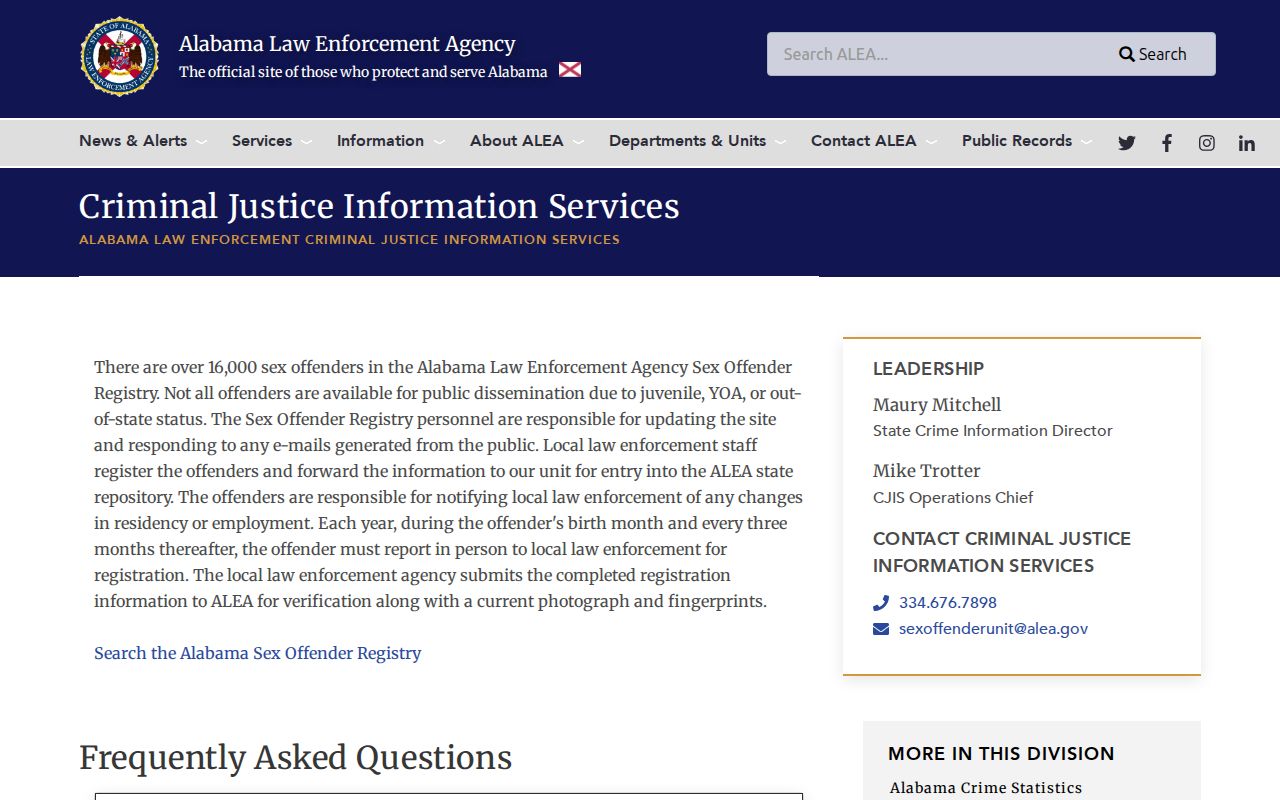
ALEA describes updates as daily or real time, but a no-result can still have several causes. The person may not be subject to public posting, a name may not match, due process may be pending, or the reporting status may have changed. Confirm the right person before drawing any conclusion.
Crenshaw County Searches Across State Lines
The Alabama registry is the best source for Alabama-specific public detail. The National Sex Offender Public Website, operated by the U.S. Department of Justice, adds a cross-state layer when a name, former address, or family safety question extends beyond Crenshaw County.
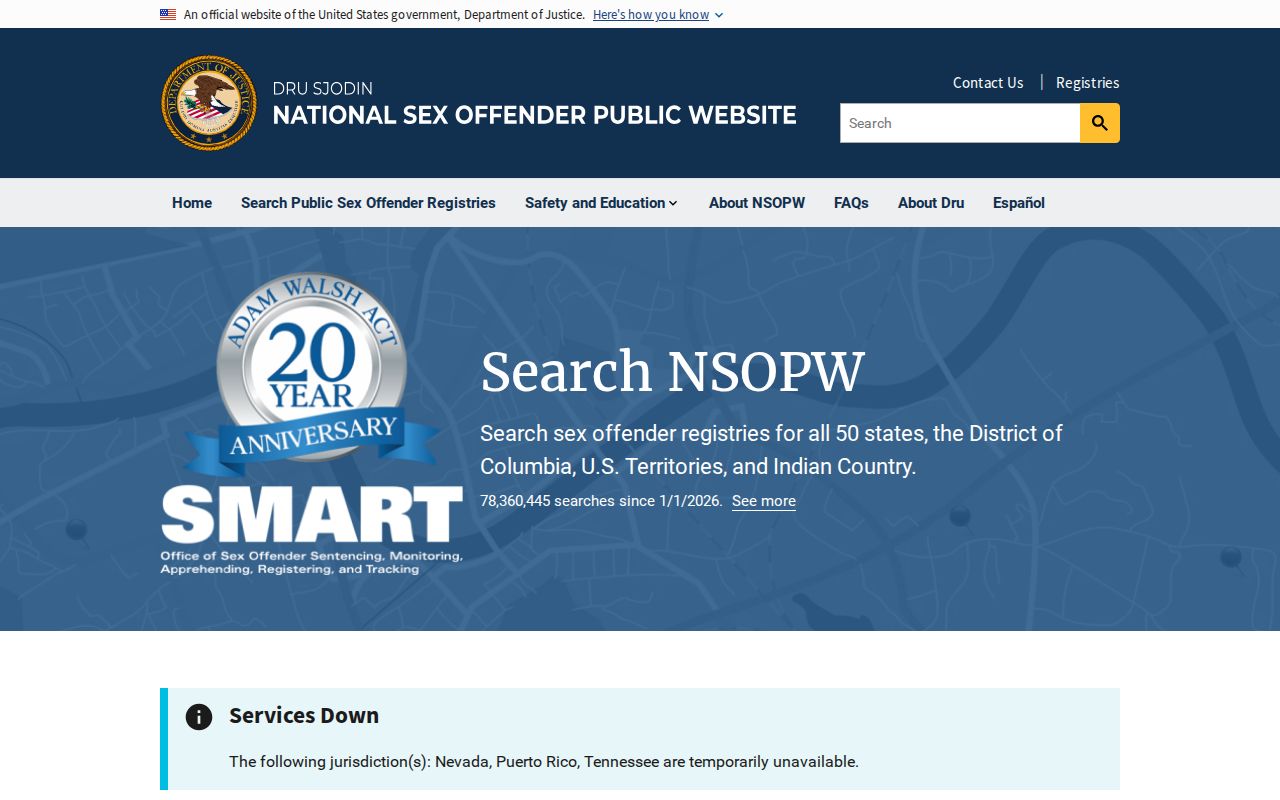
NSOPW draws from participating jurisdictions and should be used as a supplement, not as a replacement for ALEA's record. Search the national layer, then open the originating jurisdiction's official result for its definitions, dates, and local contact. A national no-result should not be read as proof that no nonpublic or pending record exists.
Crenshaw County Radius Results and Restrictions
A map radius is a search tool, not a legal boundary map. Alabama's residence, employment, school, and loitering rules use statutory facts that a circle on a screen may not establish. ALEA states that a covered person whose victim was under twelve may not loiter within 500 feet of listed child-centered places. Other duties appear in §§ 15-20A-10 and 15-20A-11.
Do not infer a violation because a pin looks close to a school, park, or other site. Map placement, property lines, offense category, victim facts, exceptions, and the current reported address can all matter. Send a concrete concern to the Crenshaw County sheriff. The agency can verify the facts and apply the law without exposing a household to confrontation.
Using Registry Information Lawfully
Crenshaw County registry information supports community awareness and personal safety planning. Local law enforcement performs notification and compliance work. Members of the public may check an address, read a profile, and report a suspected error, but they should not threaten, shame, follow, contact, or try to punish a listed person or anyone at the reported address.
Misuse is prohibited: Ala. Code § 15-20A-8(h) warns against using registry data to unlawfully injure, harass, or commit a crime against a registrant or anyone at a reported address. Civil or criminal penalties may follow.
When a profile seems stale or a person appears noncompliant, note what was observed and when, then contact the sheriff or ALEA. A no-result, a late date, or a map pin alone is not proof of wrongdoing. Law enforcement can check information that is not part of the public display.